

📋 Table of Contents
- What Is Cricket?
- Basic Equipment Needed to Play Cricket
- Understanding the Cricket Pitch
- How Batting Works
- How Bowling Works
- Fast Bowlers
- Spin Bowlers
- How Runs Are Scored
- Ways a Batter Can Get Out
- Fielding Positions in Cricket
- What Is an Over?
- Popular Formats of Cricket
- Test Cricket
- One Day Cricket
- T20 Cricket
- Beginner Tips for Playing Cricket
- Conclusion
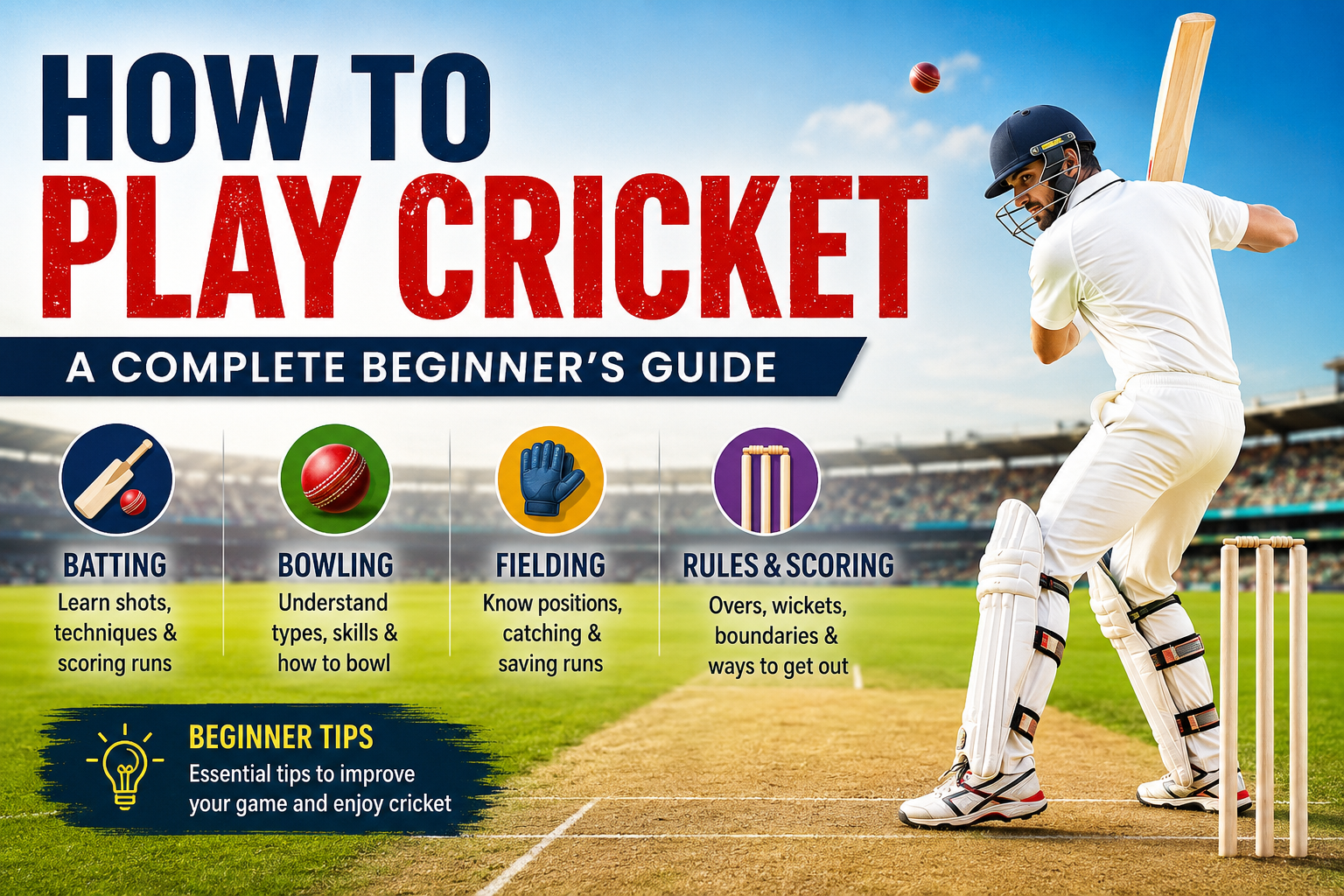
How to Play Cricket, Cricket is one of the world’s most exciting and strategic sports. For anyone looking to learn cricket for beginners, the game may seem complicated at first because it includes unique terms such as wickets, overs, innings, boundaries, and LBW. However, once you understand the basic concepts, cricket becomes easy to follow and enjoyable to play. The main objective is simple: one team tries to score as many runs as possible, while the other team tries to stop them and take wickets. This guide explains how to play cricket, the basic rules, key positions, scoring methods, and beginner tips to help new players understand the game.
For official cricket laws and detailed rule explanations, players can refer to the MCC’s official Laws of Cricket. 1
What Is Cricket?
Cricket is a bat-and-ball game played between two teams. Each team usually has 11 players. The game is played on a large oval or circular field with a rectangular strip in the center called the pitch. At both ends of the pitch are three vertical wooden stumps with two small bails placed on top. These are called wickets.
The two main roles in cricket are batting and fielding. The batting team tries to score runs, while the fielding team tries to get the batters out. After a set number of balls, overs, or innings, the teams switch roles. The team with the most runs at the end of the match wins.
Basic Equipment Needed to Play Cricket
How to Play Cricket, you need a few important pieces of equipment:
- Cricket bat: Used by the batter to hit the ball.
- Cricket ball: A hard ball used by the bowler.
- Stumps and bails: These form the wicket.
- Protective gear: Batters often wear pads, gloves, helmet, thigh guard, arm guard, and abdomen guard.
- Cricket shoes: These help players grip the ground while running, bowling, or fielding.
- Uniform: Teams usually wear whites for Test cricket and colored kits for limited-overs cricket.
Beginners can start with soft-ball cricket or tennis-ball cricket before moving to hard-ball cricket. This helps new players learn batting, bowling, and fielding safely.
Understanding the Cricket Pitch
The pitch is the central playing area where most of the action happens. It is 22 yards long. The bowler delivers the ball from one end of the pitch toward the batter standing at the other end. Batters run between the two wickets to score runs.
The pitch condition can affect the game. A dry pitch may help spin bowlers, while a green pitch may help fast bowlers. For beginners, the most important thing is to understand where to stand, where to bowl, and how to run safely between the wickets.
How Batting Works
How to Play Cricket, Batting is the art of scoring runs and protecting your wicket. Two batters are on the field at the same time. One batter faces the ball, while the other stands at the opposite end. The batter can score runs by hitting the ball and running between the wickets or by hitting boundaries.
A batter must watch the ball carefully, move their feet, and choose the right shot. Common cricket shots include:
- Defensive shot: Used to block the ball and protect the wicket.
- Drive: A controlled shot played along the ground.
- Cut shot: Played square on the off side.
- Pull shot: Played to a short ball on the leg side.
- Sweep shot: Often used against spin bowling.
Good batting requires patience, timing, balance, and decision-making. Beginners should focus first on keeping their head still, watching the ball, and playing straight.
How Bowling Works
Bowling is how the fielding team attacks the batter. The bowler runs in and delivers the ball toward the batter. The aim is to hit the stumps, force a mistake, or stop the batter from scoring.
There are two main types of bowlers:
Fast Bowlers
Fast bowlers rely on speed, bounce, and swing. They try to make the ball move in the air or off the pitch. A fast bowler needs a strong run-up, good rhythm, and accurate line and length.
Spin Bowlers
Spin bowlers rely on turn, flight, and deception. They bowl slower than fast bowlers but try to make the ball spin after it lands. Spin bowling requires finger control, wrist movement, and clever variation.
For beginners, accuracy is more important than speed. Try to bowl at the stumps consistently before learning advanced skills such as swing, seam, spin, yorkers, slower balls, or bouncers.
How Runs Are Scored
How to Play Cricket, Runs are the basic points in cricket. The batting team scores runs in different ways:
- Single: The batters run once between the wickets.
- Two runs: The batters run twice.
- Three runs: The batters run three times.
- Four: The ball reaches the boundary after touching the ground.
- Six: The ball crosses the boundary without touching the ground.
- Extras: Runs awarded for wides, no-balls, byes, or leg byes.
Running between the wickets is an important skill. Batters must call clearly using words such as “yes,” “no,” or “wait.” Poor communication can lead to run-outs.
Ways a Batter Can Get Out
Taking wickets is the main goal of the fielding team. A batter can be dismissed in several ways, including:
- Bowled: The ball hits the stumps and removes the bails.
- Caught: A fielder catches the ball before it touches the ground.
- LBW: The ball hits the batter’s leg when it would likely have hit the stumps.
- Run out: A fielder breaks the wicket while the batter is outside the crease.
- Stumped: The wicketkeeper breaks the stumps when the batter misses the ball and steps out of the crease.
- Hit wicket: The batter accidentally breaks their own wicket while playing a shot.
Beginners should focus on protecting the stumps, staying inside the crease, and avoiding risky runs.
Fielding Positions in Cricket
How to Play Cricket, Fielding is just as important as batting and bowling. Fielders stop runs, take catches, and create pressure. Some common fielding positions include:
- Wicketkeeper: Stands behind the stumps and catches balls missed by the batter.
- Slip: Stands beside the wicketkeeper for catching edges.
- Point: Stands square on the off side.
- Cover: Fields in front of point.
- Mid-off and mid-on: Stand closer to the bowler on either side.
- Square leg: Stands on the leg side.
- Fine leg: Stands behind square on the leg side.
- Long-on and long-off: Boundary fielders straight down the ground.
Good fielding requires quick reactions, safe catching, accurate throwing, and strong fitness.
What Is an Over?
An over is a set of six legal balls bowled by one bowler. After an over is completed, another bowler bowls from the opposite end. A bowler cannot bowl two consecutive overs.
Overs help structure the game. In limited-overs cricket, each team gets a fixed number of overs. In Test cricket, teams bat for longer periods, and the game is played over multiple days.
Popular Formats of Cricket
Cricket has several formats:
Test Cricket
Test cricket is the longest format. It is played over up to five days and focuses on patience, skill, and strategy.
One Day Cricket
One Day Internationals, or ODIs, are limited-overs matches where each team usually gets 50 overs.
T20 Cricket
T20 cricket is the shortest major format. Each team gets 20 overs, making the game fast, exciting, and aggressive.
Beginners often enjoy T20 because it is quick and easier to understand.
Beginner Tips for Playing Cricket
If you are new to cricket, start with the basics. Do not worry about advanced techniques too early. Here are some useful tips:
- Watch the ball carefully when batting, bowling, or fielding.
- Practice straight batting before trying powerful shots.
- Bowl at the stumps and focus on accuracy.
- Use proper protective gear when playing with a hard ball.
- Warm up before playing to avoid injuries.
- Communicate clearly while running between wickets.
- Stay alert in the field because the ball can come quickly.
- Learn the basic rules before playing competitive matches.
- Respect teammates, opponents, and umpires.
- Practice regularly to improve timing, control, and confidence.
Read More: Best Cricket Prediction Apps (2026): Top AI Apps for Match Predictions & Fantasy Cricket
Conclusion
How to Play Cricket, teamwork, patience, and strategy. To play cricket well, you need to understand batting, bowling, fielding, scoring, and dismissals. Beginners should start with simple drills, learn the basic rules, and gradually develop advanced techniques. Whether you want to play casually with friends or train for competitive cricket, the key is regular practice and love for the game. Once you understand how cricket works, every ball becomes exciting and every match becomes a chance to improve.


